11 April 2020

The Great Pause

I suppose it’s been about a month now since we’ve been making the effort to stay home because of Covid-19, including four weeks of school closure.  It’s tough to know without referring to the calendar, because most days morph into the next with little distinction.  Really, though, for me it seems longer because I made a conscious decision – not related to Covid-19 – to hibernate over my spring break. This has been a tough school year for me, teaching four different classes, with one of them totally new to me and beyond my area of expertise (AP Psychology).  So I’ve spent the past twenty-seven weeks of school trying to stay one step ahead of my students.  It’s not been easy because even though psychology is considered by many to be a social science, it’s pretty darn science-y, requiring knowledge of brain anatomy, how each of our senses relay information to the brain, and the processes of intricate mechanisms like how neurons work, among other things.  

So by the time Spring Break came along, I was pretty damn tired. 

These weeks since, with worrisome headlines about deaths, grocery shortages, and continuous announcements of closures, have been pretty anxiety-inducing.  I have tried to carry on with my Spring Break activities, which fill me up.  My daily activities have included hiking, yoga, gardening, and reading.  And I’ve been sleeping a lot.  

Like many of you, I’ve been using this time to reflect.

I’m grateful that I am still working, even if from afar, and still receiving a paycheck.  What I like about online education:  I can set my own hours.  What I miss about the old way of teaching:  interacting with my students.  Sure, we can email and have virtual meetings, but it’s not the same as seeing their faces in person and knowing that they understand or need more assistance.  Some of them are facing really tough times at home, with parents losing jobs, or working way more hours than usual, and in the past week, a couple of them have gotten reminders that other diseases, like cancer, do not take holidays during a pandemic.

I’m grateful for these extra hours with my daughters, especially.  They’re both at ages where they would likely be spending far more hours away from home than they currently are.  Having all four of us in the house is not always easy, especially with the added stress of quarantine life, but it’s a gift of time together that we will likely never have again.  

I’m grateful for enough time in my days to prepare dinners.  I’m a pretty lazy cook, always looking for shortcuts and meals that might leave enough leftovers for a second night.  But during these days, I’ve made meals requiring more effort than normal. And while we’ve certainly done our fair share of take-out, trying to keep our favorite sandwich shop and Mexican hole-in-the-wall solvent, it’s been almost meditative, spending time in the kitchen preparing food for those I love.   

I’m grateful that, for once, I’m spending enough time in the garden in these early spring days to actually have some things planted.  Typically, the fourth quarter of school is also one of the busiest, and so all my gardening aspirations continually got pushed back, and pushed back, until suddenly, it was the end of May by the time I had time to plant.  Robust wildflower seedlings are appearing, and I’m enjoying watching the incremental bloom occurring on my redbud and crabapple. The pear tree is already leafed out after its most spectacular bloom in memory.  

I’m grateful that I’m getting around to tackling small jobs around the house that have been pushed aside for more time than I’d willingly admit.  I made a list of tasks and cut the paper into strips.  On days when I feel as if I have enough energy to draw one from the bowl, I do.  And sometimes I let that task sit a few days until I feel like doing it.  I’m being productive, but not to a fault.  I have been giving myself permission to choose not to do whatever task it is, and sometimes, I’ll draw one and put it back.

In spite of all this gratitude, though, there have been days when I’ve felt so bluesy.  There is so much grief.  I easily get teary-eyed and don’t have as much patience as I would like. I am so sad for this year’s senior class, including my niece, who will be foregoing traditional rituals that they’ve anticipated their entire school career.  Madeleine’s graduation from Yavapai College was cancelled.  Arden had applied for a summer exchange program that was cancelled.  My nephew’s wedding celebration was called off.  All of these things pale in comparison to those losing loved ones to Covid-19, certainly.  But grief is grief, and it is hard work to work through it, harder still when you can't physically be comforted by friends and extended family.

And yet, what a time to be alive.  Thanks to technology, I can FaceTime my octogenarian parents and see and hear them and know they are well.  I can find materials to share with my students that have authentic French-speakers, or ready made test-prep materials for my AP Psychology students – who are still scheduled to take a high-stakes test in a month’s time.  I can travel the world in the social media photos of friends living all over this planet.  I can reminisce about last summer in Perú, scrolling through my photos and words on this blog.  And I know that I am not alone in this strange time, knowing that this Great Pause, as I saw it referred to today, is happening to all of us earthlings.  When else have we suffered together across borders and it wasn't caused by ideology or greed?  I am not sure I have ever felt so connected to my fellow humans, in spite of our physical distance from one another.  

What will we learn from this?  What will we shed?  And what will we cultivate, having been thrust into this Great Pause, those of us who have been given the time to hop off of our hamster wheels?  What nuggets of wisdom and truth are you planting in your gardens?

19 March 2020

How's it Going to End?

Yesterday I drove through the fog and rain to Phoenix to see my breast cancer surgeon.  Due to a series of mildly unfortunate events, I couldn’t play music or even listen to the radio, which left me alone in my thoughts. As I drove, I thought of other doctor appointments I’d had.  A couple years before my cancer diagnosis, I’d had a weird mammogram, which led to a biopsy.  The results of that test were delivered to me by phone.  Good news often is.  And so when I was told to come see the doctor whose office had ordered a second biopsy, a couple years later, I already knew that the results were not good.  Even so, when that doctor delivered my results to me, his face buried in my file, without a greeting or even eye contact, I felt like I was drowning.  I found another doctor, the one I was on my way to see now.  I remember how, at my first appointment, she hugged me and Dan, such a contrast to the previous doctor.  

For this current appointment, though, there were no hugs, due to the Covid-19 pandemic.  She stood at a distance and “air hugged” me.  After my examination, she asked if I was comfortable with this being my last appointment with her.  With no further evidence of cancer these past seven years, she felt that my primary care physician was more than capable; that her specialized skills weren’t required.  I agreed. We chatted a bit more, mostly about Covid-19 and how it’s affecting her patients.  We both wondered aloud about when it would end and how it would end. And then we “air hugged” one last time and I left her office.

Leaving her office for the last time, I felt a strong sense of gratitude, like I’ve felt over the last several years.  Usually, I’ve treated myself to a lunch with my sister or my cousin afterwards, or a long hike in the desert mountains.  But this time was different.  I drove home in the silence, thinking about my own experiences with illness and wellness, and about the lives affected by this pandemic.

I thought of the patients of my doctor, who have surgeries scheduled for today, but who probably won’t be admitted to the hospital because their last chemo date was less than four weeks ago.

I thought of my students, who are in various stages of coping, trying to make sense of this new normal we’ve been thrust into.

I wondered about how I will be able to deliver content to my students online without them having too much screen time.

I thought of exchange students who were in my classes who are being sent home, without being able to say goodbye to the friends they’ve made.

I thought of all the people around the world whose incomes are suddenly zero because their jobs are on hold.  

I thought of friends and family who are medical professionals and the stress and challenges that they will meet in the coming days and weeks.

Madeleine asked me the other day if 9/11 had a similar sense of palpable fear.  It’s been interesting to think about these two events, but they are so different from one another.  Yes, there was so much fear with 9/11 – and remember the anthrax mailings – but there was also a strong sense of unity as a nation.  This time, there is no one to direct our anger at, regardless of how much the president tries.  This time, there is less sense of community because some of us are not doing the right things, like hoarding toilet paper.  

But there is also such beauty and kindness and generosity.

I thought of videos I’ve seen of Spanish and Italian communities sharing music – which might be humankind’s most beautiful creation – on their balconies during this time of lockdown.

I’ve been the very grateful recipient of countless other teachers’ generous sharing of lesson plans, platforms, and ideas on ways to connect with our students.

I thought of people sharing recipes, games, and silly activities to do while we are stuck at home.

I thought about all the humor that is being shared and all the appreciation for medical professionals, teachers, first responders.

I keep thinking of The Truman Show, and the question on everyone’s minds:

How’s it going to end?


16 July 2019

Fulbright TGC: Solpayki

At breakfast this morning I was alone because Dan left last night.  My flights were arranged by the Fulbright program, and because I have an absurd history of sometimes being confused by dates while traveling, I am not on the same flight, so I am still in Lima while he's finished the first leg of his journey home.  So I brought with me to breakfast a copy of the Little Prince in español with the goal of hopefully finishing the book before my return.  I've read it many times and it's my favorite book, written by Antoine de Saint-Exupéry, Frenchman and WWII pilot.  It's a strange story of a man stranded in the Sahara where meets the title character.  Over a short period of time and despite communication barriers, the man finds himself inexplicably drawn to and responsible for the little prince.  The story is an allegory, so the literal telling is layered with symbols and situations that represent much more than is apparent.  Without spoiling it for those who haven't read it, the recurring motif is that the most precious things are hidden and it's difficult work to truly appreciate the value of friendship and connections with others.

As I was reading this morning at my table, a young waiter approached to refill my café con leche and he commented on my book, asking me in French if I were French.  I told him that I am from the United States (having learned that there is some resentment in Central and South America that those of us from the US call ourselves Americans even though everyone from North, Central, and South America are technically also Americans).

"That's my favorite book," he told me in English, and I agreed it is mine, too.  He continued that he'd read it in France while visiting his sister.  We ended up talking for a while about the book in a curious mixture of French, Spanish, and English.  And after he left, I found myself feeling pretty emotional (again) about this experience in Peru ending.

I can't wait to get home.  I miss my daughters.  I miss the lovely home we've created.  I miss Mexican food, my own bed, my own shower.  This experience has challenged me in ways I did not expect and has left me feeling humbled and grateful for many things that are difficult to communicate.

I came to Peru with three guiding questions to help me narrow the focus my attention:
What opportunities exist for bilingual education?
What languages are taught?
Are indigenous languages taught elsewhere in Peru?

After my school visits in Tarma, I felt that while there are mandates from the national curriculum that English be taught in every school, there are often no real opportunities for students to truly acquire English in regular public schools.  These students often have only about 90 minutes of English a week.  If they are lucky, they have a teacher like Clever who is quite proficient in English, having spent time in a Fulbright program in Montana as well as having had an educational opportunity in England.  (Students at COAR schools in Peru, which many of my Fulbright colleagues visited, have English class daily.  These schools are public but students are admitted by application only - high test scores and a satisfactory psychological test are required to attend these boarding schools.) However, many of the English teachers we met and worked with in the Tarma area struggled with their own English skills.  They lacked confidence about their ability to speak and teach it, but they were definitely committed to doing their best, coming to workshops my co-teacher and I hosted for them.  I did not find the answers to my other two guiding questions in Tarma, but answers would reveal themselves later in this journey - just as in the Little Prince, they were not easily visible.

Dan met up with me at the end of my Fulbright program and we flew to Cuzco for a guided trek and visits to Inca ruins.  I still had yet to hear anyone speaking Quechua, the indigenous language of many people living in the Highlands, but I'd found in Lima a copy of the Little Prince in Quechua.  I bought it because I apparently have started to collect this book (with this copy I now have it in four languages) and also because we had been learning from workshops that resources in Quechua are limited.  I wanted to support the translation efforts.  The lack of resources printed in Quechua reminded me of similar issues on the reservations in Arizona, where Native Americans don't have resources printed in their indigenous languages, like Navajo.


It wasn't until we were in the van driving to the trailhead for our Choquequirao trek, with my Quechua copy of the Little Prince stowed in my luggage left in storage at the hotel, that I finally heard Quechua.  In the backseat of the van were three men who were accompanying us on our trek as cooks and an assistant guide, and they were speaking to one another in Quechua.  It appeared that Milton, the assistant guide, was telling stories and the two other men would laugh and comment - this went on during the entire drive, a long story punctuated by laughter and a short commentary, and then Milton would begin a new one.  Quechua sounds like no other language I have ever heard.  I was finally hearing the language of the Incas.

Over the next few days, I learned that in Cuzco and some other areas, many schools do teach Quechua, alongside English and Spanish.  Our guide's daughters, who have Quechua names, were learning Quechua in school.  William, our guide, learned Quechua from the assistant guide, cooks, and horsemen, as they worked together on the Inca Trail and other treks.  It was also heartening to see street names, restaurants, and more with Quechua names in Cuzco.  Spanish is definitely the predominant language, but it was good to see that the indigenous language has such a presence in the city.  In Plaza de Armas, the main square, there is a statue of Pachacuti, the Inca who united the empire.  I was expecting Francisco Pizarro, the leader of the Conquest of Peru, much like you'll find statues of Confederate leaders in the Southern US.  It was a pleasant surprise not to see the Spanish Conquistadors, whose greed was so brutal and so violent, held up as heroes.

In a roundabout way, I found the answers to my guiding questions and learned a most important word in Quechua:  solpayki (thank you).  On our trek, which was more challenging than anticipated, I woke up on the third day with a fever and sore throat.  My second visit to the ruins of Choquequirao was out of the question as I shivered in my sleeping bag trying to warm my aching bones.  When I felt a little better, I set off with Milton to hike down to that night's camp, while Dan and William returned up the mountain to Choquequirao.  Milton was obviously concerned about me, and while I felt better, I was still feeling weak as we hiked.  He and I had bonded earlier, after realizing that we are both fifty years old.  We spoke in Spanish about basic topics, like family and the weather, to pass the kilometers, and I thought about the narrator and the little prince and their communication difficulties, being a traveler in another land, and the challenges faced by the people in the communities were passed through.  These were agricultural people, living on small plots and farming corn, potatoes, and quinoa; raising pigs, sheep, and chickens.  They plowed their fields with a horse or a mule and used hand tools.  Their homes are small adobe dwellings of one or maybe two rooms, and they rent campsites to people like us for extra income.  It was a bit like time travel, but some places had electricity from solar panels and some even advertised wifi.  Dan and William caught up with us at our lunch break and I felt somewhat better that evening.

Before I came to Peru, I did not have an idea of how diverse this country is in terms of geography, climates, people, languages, and experiences.  Lima is so different from the rest of the country, and yet Lima itself is not easily quantifiable either.  I did not understand what poverty truly looks like, and how lack of infrastructure impacts daily life.  I did not comprehend the effects of corruption and how that plays out in the lives of regular people.  I could not fathom the depth of patriotic pride that nearly all Peruvians demonstrate, wearing ribbons and pins of the national colors or the jerseys of the national soccer team.  I am astounded at the busy activity everywhere in Peru.  There are people everywhere, at all hours, buying, selling, cleaning, building, walking.  Even in Tarma, which I imagined as a sleepy mountain town, there is a bustling energy even on Sunday evenings.  I have been so surprised at the warm welcome I have received wherever I go:  handshakes, kisses on the cheek, buenos días from person after person every morning and buenas noches every night.  I have wondered at the reception a Peruvian might receive in the US.  I intend to continue working remotely with the English teachers in the Tarma area, and to share with my students how similar they are to Peruvian students:  a love of pizza, deep pride in identity, a polarizing view of K-Pop (are you a lover or a hater?), an insatiable need to take selfies, and a desire to learn more about the world.

I hope that I have been a gracious guest and I am anxious to take the lessons I am still learning home with me.  I do not know if I will ever return to Peru, but I am so grateful for all of my experiences here, especially the ones that were challenging and difficult.  Perhaps Anthony Bourdain said it best:

“Travel isn’t always pretty. It isn’t always comfortable. Sometimes it hurts, it even breaks your heart. But that’s okay. The journey changes you; it should change you. It leaves marks on your memory, on your consciousness, on your heart, and on your body. You take something with you. Hopefully, you leave something good behind.”


On the last night of our Choquequirao trek, we stayed in a rustic cabin in Capuliyoc, the literal end of a very narrow and bumpy road.  Looming across the valley was the glaciated peak of Padriyoc - perhaps 19,000 feet at its summit.  After dark, William pointed out constellations in the Inca system, like Yacana - a mother llama with her suckling baby -  as well as the Southern Cross.  The Southern Cross has been used by navigators for centuries, and I was again reminded of our insignificance on this tiny planet in a vast and expanding universe, yet I did not feel unsettled by it. Rather, I was comforted by this distant symbol and its importance across the ages to people traveling and thinking of home.

04 July 2019

Fulbright TGC: End of IFE

My Fulbright Teachers for Global Classrooms International Field Experience officially ended yesterday.  I have met with a network of Peruvian teachers and administrators, worked with students, and been debriefed.  Some of the teachers in our group have already begun planning subsequent projects and collaborative activities, however, I have been letting this experience slowly percolate through me and absorb into my being.

The past few days have been pretty low key and fun.  Several of us visited the Museo Larco and learned about pre-Incan cultures.  The gardens there were breathtaking.


I took a couple of yoga classes - all in Spanish - which was pretty challenging physically and mentally.  I went for a walk along the coastal cliffs.  Our last official day we had a tour of the Mercado 1 in the Surquillo neighborhood.  This is the most highly regarded food market in the city.  There we tasted fruits, learned about the wide varieties of corn and potatoes that are native to Peru, and held crabs that were caught so recently they still moved.  Later we had a culinary lesson where we made our own pisco sours and ceviche.  

Cocoa bean.  We tasted the fruit that encases the seeds (the seeds are what chocolate is made from).

Fruit stand.  

David, our guide showing us potatoes (look at all the types on the shelves behind him).

Dry goods and spices.  Check out the size of the cinnamon sticks!

Assembling the ingredients for pisco sour (3 parts pisco, 1 part lime juice, 1 part simple syrup, 1 egg white, ice - shake well.  Pour into glass being sure to rinse the foam from the walls of the shaker into the glass.  Top with 2-3 drops Angostura bitters.)


Ceviche ingredients - missing only the fish.

The chef who taught us the ceviche process.

Adding lime juice to the fish.

The finished product with sweet potato, Peruvian giant corn, and seaweed garnish.

Mixing my own pisco sour.

The night and the IFE ended with a delicious dinner on the water.  

Now that I have met, listened to, and worked with Peruvian educators, I have a better understanding of many of the issues and challenges facing education in this country.  I am deeply moved and humbled by the dedication and motivation these educators have, especially in spite of language barriers, wildly diverse geographic zones, and an influx of very welcome immigrants.  In many ways, I feel that my own education is just beginning.  


28 June 2019

Fulbright TGC Day 10-11: Last days in the classroom

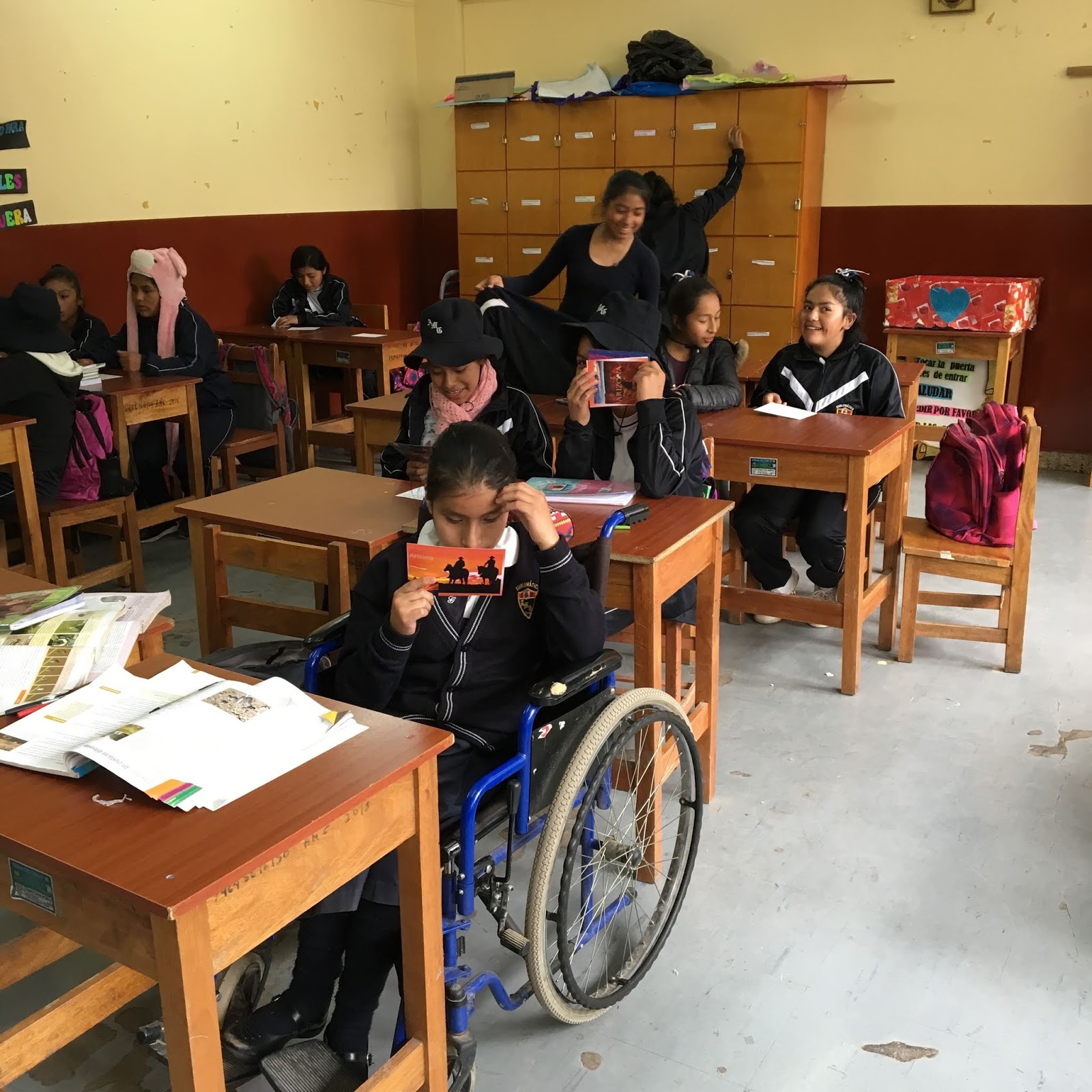
The past week has been a whirlwind, and while overwhelming at times, such a meaningful and powerful experience.  Over the past two days we continued to teach.  Much of each lesson was centered around postcards that my students had written to the students here in Tarma.  The reaction from each class at learning that these postcards had messages for them was so sweet and adorable.  Today and yesterday many Tarma students wrote back to my students.  It will be fun to share these with my students and bring this activity full circle.


When we first communicated with our host teacher, Clever, he asked us  create some "science experiments" for his students.  I definitely have no experience in developing science experiments, however, this entire Fulbright experience has been about stepping outside of my comfort zone, so I was happy to come up with something.  My activity isn't really science based, but is more of a problem-solving, team-building activity.  It involved Peruvian Cheerios (called Mel), string, and a few other items.  The goal was to get the Cheerios onto the string without touching them with your hands (other items were ok) without speaking.  The string would be held vertically when time was up and each team would get one point for each Cheerio that remained on the string.  It was interesting to see how the students approached the problem.  I did this activity at two different schools.  The first group had very young students (equivalent of US first graders) all the way up to 11 year olds.  The second group was older kids.  The older kids enjoyed it so much they wanted to do it again, but the second time each team member could only use one hand.  We had to up the ante since they'd already worked through it once.  The older girls ended up picking up a piece of the cereal with their mouth while their partner put the string through the hole.  The underlying message here is that by working together and using creativity to overcome obstacles, we can solve problems we face.


After all these activities with the students, some parents arrived with the principal to thank us for our time and efforts this week.  It was a very nice and casual ceremony with an exchange of some gifts of appreciation.  My partner and I were each asked to speak a few words and I found myself feeling surprisingly verklempt.  


In the evening, about ten teachers arrived from within Tarma and neighboring towns for one final teacher workshop... On a Friday evening... After they had been teaching all week.  Some even traveled more than 40 minutes one way.  The dedication of these teachers is inspiring and touching.  They want so badly to improve their own English skills and to help their students.  English is a required subject in the nationalized curriculum, however, there are so few teachers who truly are proficient in English, that many times a teacher is assigned to be the English teacher even if he or she speaks little English.  Such commitment and resolution are not unusual in this profession, but I have to say that I was so impressed that they were willing to give up their Friday evening.  And not only for the teacher workshop, but they took us out for Chinese food afterward.  The intention is to collaborate on future Internet-based projects to help improve English skills of both the teachers and the students.  We had a great time at dinner, sharing dumb jokes and tongue twisters in both English and Spanish.  But my favorite phrase of the evening, and you can relate if you've ever been in a big group that can't quite seem to get moving forward:  calabasa, calabasa, todos a su casa!  (Pumpkin, pumpkin, everyone home! - but way better in Spanish because it rhymes!)

Our final day in Tarma was full and valuable and reminded me of the many reasons why I love being part of this profession.