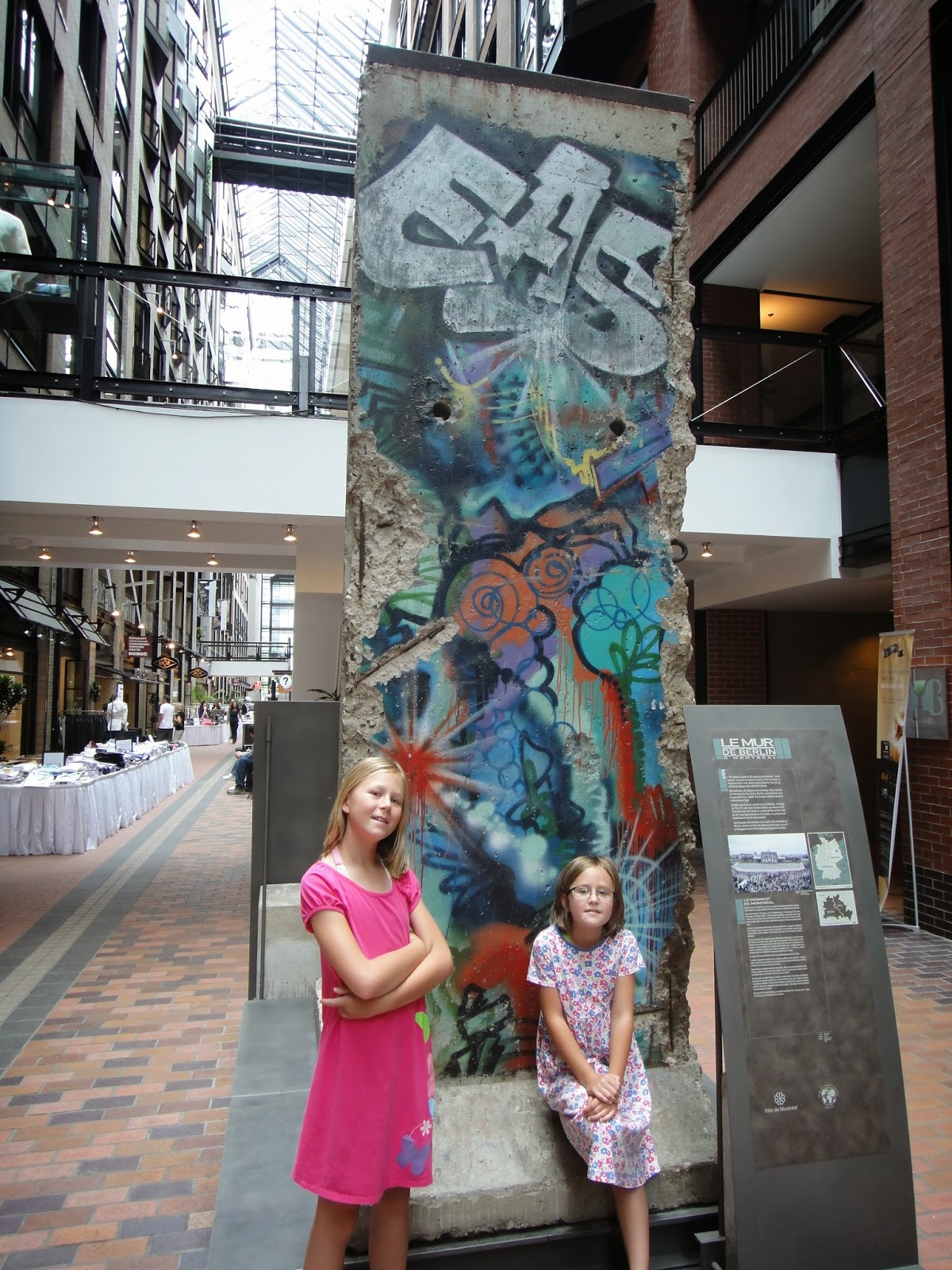
I spent Independence Day and most of the first week of July hosting a
family from Czech Republic in our home. Eight years ago, we volunteered
to host the daughter of this family for a summer program. This summer, she returned with her parents
who speak minimal English (although more English than my Czech, which is pretty
much limited to “cheers!”). There is something incredibly powerful and also humbling about inviting
a foreign stranger to stay in your home.
Following World War II, when it was abundantly clear that we were in
great need of international goodwill, programs like the Fulbright were
developed to foster the exchange of ideas between nations. Unfortunately, the world at large remains in
dire need of international goodwill, but I still want to believe that it is
possible to bridge the gaps that divide us by building personal relationships
with those we perceive as different from us.
I was the lucky recipient of another family’s commitment to
international goodwill in 1989, when I participated in a program in Paris. 1989 was the bicentennial of the beginning of
the French Revolution, which was a divisive and violent period of paranoia and
misguided patriotism, but which ultimately gave the world one of the
fundamental documents for human rights, the Declaration of the Rights of Man
and of the Citizen, which was of course modeled after the American Declaration
of Independence and US Constitution. I
studied the Declaration of the Rights of Man and of the Citizen in 1989 as I
visited sites impacted by the Revolution.
It was easy to get caught up in the spectacle of the celebrations,
especially while singing La Marseillaise in the streets around Place de la
Bastille while swigging from passing bottles of wine and dodging errant
firecrackers. But the best part was developing relationships and interacting with the French, which isn’t easy, as
any tourist will tell you. But I insist
that it is worth the effort.
It is worth the effort to go outside of your comfort zone. It is worth the effort to learn another
language, even if only the most basic tourist essentials (please, thank you,
hello, goodbye, thank you, thank you, thank you). It is worth the effort to study the history
and culture of another place, even if at first it is only on a superficial
tourist level. But you must reach for
this reward, you must work for it, and you must listen to strangers.
1989 is a year that not only markedly altered my life, it was also the
year that ended with the Berlin Wall coming down and the Velvet Revolution in
what was then Czechoslovakia. The end of
Communism in Europe and the end of the Cold War were defining historic moments
of the beginnings of my adulthood, including my first teaching job, when I
taught English to children who had fled the breakup of the Soviet Union. Of course, in 1989 as I watched these events
unfold with my jaw on the floor of my Tucson apartment, I had no idea that many
years in the future my family would be having dinner with a family who had
lived on the other side of the Iron Curtain.
I had no idea that we would be discussing Ronald Reagan, freedom, and
the hoops one must jump through to get a new washing machine in a Communist
state.
Here’s what I learned: families
are the same regardless. People have the
same hopes and dreams and love for their children. Parents in a socialist republic, and an
Eastern bloc state, or here in the USA, love their children and their
neighbor’s children. They want the next
generation to have opportunities they lacked and to exercise their rights and
to leave the planet better. And it’s the
same for black families. And Muslim
families. And gay families. And any combination of the above. But it can be difficult to recognize unless
we have an anchor to which we can attach our acknowledgement of what unites
us. That anchor is a relationship with
someone. One person at a time. I am amazed and deeply touched by the
attachment I’ve formed with our Czech family, in spite of our inability to
converse directly without the translation skills of their daughter, who is very
precious to us. We feel blessed to have
had the opportunity to share with them our town and our nation’s independence
and freedom, and to have a renewed interest and appreciation for such after
seeing them through their eyes.
The day after our Czech family departed, my daughters and I had the
opportunity to visit a nearby ranch.
We’d been invited by a dear friend but had not previously met the
host. Regardless, we were welcomed
warmly, and treated to unique and fun opportunities, like his private zip line,
low ropes course, and feeding hummingbirds by hand. I had never met this man, but he treated us
like old friends and made us feel so welcome – like, I hope, our Czech family
felt with us.
This past week, the Dalai Lama said, “I consider we are all the same as
human beings, mentally, emotionally, and physically. In order to ensure a more peaceful world and
a healthier environment we sometimes point the finger at others, saying they
should do this or that. If one
individual becomes more compassionate, it will influence others and so we will
change the world.”
We have had a tough go of events these past many weeks here in the US
specifically, and in the world at large.
There has been too much violence.
Too many senseless deaths. Too
little compassion. Too many valleys
dividing us and too few anchors in our common ground. We are better than our political divide. Better than our racial divide and better than our
religious divide. And it might take
generations to come closer together. But
we have traveled a long road since the year of my birth, 1968, which was also a
year of terrible violence and division.
But 1968 was also the year that gave us the Civil Rights Act, Special
Olympics, the first Medal of Honor awarded to a black Marine, the admission of
women to Yale University, the Beatle’s White Album, the computer mouse, and
René Cassin receiving the Nobel Peace Prize for his work on the Universal
Declaration of Human Rights (1948) which, you’ll recall, found inspiration in
the document that was instrumental in the French Revolution.
What if our politicians extended a hand across the aisle? What if we took the time to know not only our
neighbor’s children, but also the children of someone different from us? What if we embody compassion (sympathetic
consciousness of others’ distress together with a desire to alleviate it)? As the Dalai Lama said, it begins with
individuals. It begins with us – not them
– us. It begins with an open heart, a
willingness to listen without judgment, without politics, and without fear.