10 June 2014

Miz Maya and the Lesson of the Butterfly

Maya Angelou was laid to rest this past weekend.  I’ve always thought of her as Miz Maya.  To use just her first name seems too informal, almost disrespectful, so I’ve always thought of her with the ‘Miz’ before her name.  I don’t recall my age when I first came across her lovely words, but I know it was the famous memoir of her difficult childhood, I Know Why the Caged Bird Sings.  Before I’d even read the book, I was entranced by the title.  Here was a secret, and she was going to share it with me – with me.  This title, from a poem by Paul Laurence Dunbar, resonates with most young people, really, feeling boxed in by society and parents and siblings.  As has been said a hundred times over, it’s the powerful story of a poor black girl growing up in the American South in the 1930s.  By the time I’d found I Know Why the Caged Bird Sings, I’d already read Mildred D. Taylor’s Roll of Thunder, Hear My Cry.  I loved that book, so I figured I’d try Miz Maya’s.

Since Miz Maya’s death last week, the section in I Know Why the Caged Bird Sings where she recounts the horrific tale of her mother’s boyfriend sexually attacking her has been referred to many times.  His subsequent arrest and release and murder, presumably by some of her family members, led to her decision to stop speaking for many years.  Even as a child, she understood the weight of words.  Words can harm and destroy, but as she learned later for herself and so eloquently demonstrated for all of us, words have also the capacity to raise us up, to comfort, and to heal.

Miz Maya’s legacy to us is that we are changeable creatures in charge of blazing our own paths.  We don’t have to accept any label, whether slapped on by society or by our own thought processes.  Just because we are labeled as X does not make us incapable of becoming Y.  If you read the long list of occupations that Miz Maya held, you’ll see that we are only bound by what we dare to dream:  dancer, prostitute, activist, mother, journalist, writer, university professor, Poet Laureate of the United States.  She is proof that we can change and alter our destinies in ways that we might have been unable to envision for ourselves.  Although I haven’t yet read it, I have always loved the title of another of her books, Wouldn’t Take Nothing For My Journey Now.  In spite of the problems we encounter in our lives, isn’t it true that we’d prefer our own troubles to taking on someone else’s?  This acceptance of who we are is the very foundation upon which our happiness is built.

I don’t think I’d ever heard Miz Maya’s voice until I watched her recite “On the Pulse of Morning” at Bill Clinton’s presidential inauguration.  If you have never heard her voice, treat yourself to her rich timbre, her beautiful phrasing.  The poem carries such a lovely sentiment of unity and of hope.  It would be Miz Maya that I would choose, if from all the famous people in the world, I could sit and have coffee and talk with one of them.  In spite of her larger-than-life stature, she was firmly grounded.  Here are some of my favorite of her sayings:

I did then what I knew how to do. Now that I know better, I do better.

I've learned that no matter what happens, or how bad it seems today, life does go on, and it will be better tomorrow. I've learned that you can tell a lot about a person by the way he/she handles these three things: a rainy day, lost luggage, and tangled Christmas tree lights. I've learned that regardless of your relationship with your parents, you'll miss them when they're gone from your life. I've learned that making a "living" is not the same thing as making a "life." I've learned that life sometimes gives you a second chance. I've learned that you shouldn't go through life with a catcher's mitt on both hands; you need to be able to throw something back. I've learned that whenever I decide something with an open heart, I usually make the right decision. I've learned that even when I have pains, I don't have to be one. I've learned that every day you should reach out and touch someone. People love a warm hug, or just a friendly pat on the back. I've learned that I still have a lot to learn. I've learned that people will forget what you said, people will forget what you did, but people will never forget how you made them feel.

We delight in the beauty of the butterfly, but rarely admit the changes it has gone through to achieve that beauty.


Rest in peace, Miz Maya.  The world is a better place, thanks to your presence.

03 June 2014

Walls: reflecting on Tiananmen, Paris, Berlin, and the power of words

Twenty-five years ago, I embarked on my first big independent movement, traveling to another continent for study-abroad, just as a pro-democracy movement was being crushed in China.  When I left the United States on May 31st, 1989, I’d been intrigued by the protests and demonstrations going on in Beijing and elsewhere in China.  As I arrived in London for a few days prior to my participation in a summer program in Paris, all eyes were on Tiananmen Square and the impending crackdown on the protestors.  I was perplexed, though, that all the news in London was focused on a city called Peking.  I gradually realized that Peking was the British Imperialist name for Beijing.  It was the first of many realizations that summer on the naming of things, as well as the similarities that bridge our gaps and the differences that divide us. 

By the time I reached Paris, on June 3, the Chinese military was destroying the democracy movement without mercy.  When I first saw the iconic photograph of the lone man standing defiantly before the line of tanks in Tiananmen Square, it was on the front page of a French newspaper at a kiosk near my Métro stop in southern Paris.  The headlines and news reports were largely unintelligible to me on my first days in Paris.  My French was not yet proficient and I felt so removed, not only from my home in Arizona, but from these fellow college students half a world away in China.  I don’t think I’ve ever felt as isolated as I did those early days as I wondered what was happening to them and their dreams.  It seemed so unjust that just as I was fulfilling one of my lifelong dreams that theirs were being mowed down.

What is difficult for me to remain cognizant of is that back then, in 1989, the Soviet Union still existed and Europe was still divided.  My arrival in Paris was only two years after Ronald Reagan’s famous speech at the Brandenburg Gate when he implored Mikhail Gorbachev to “tear down this wall.”  After our program in Paris was done, I traveled for a while in Italy and West Germany with a friend.  We briefly considered a trip to Berlin, but the idea of traveling through East Germany – what we’d been brought up to believe was enemy territory – terrified us.  We opted for the biergartens of München instead.

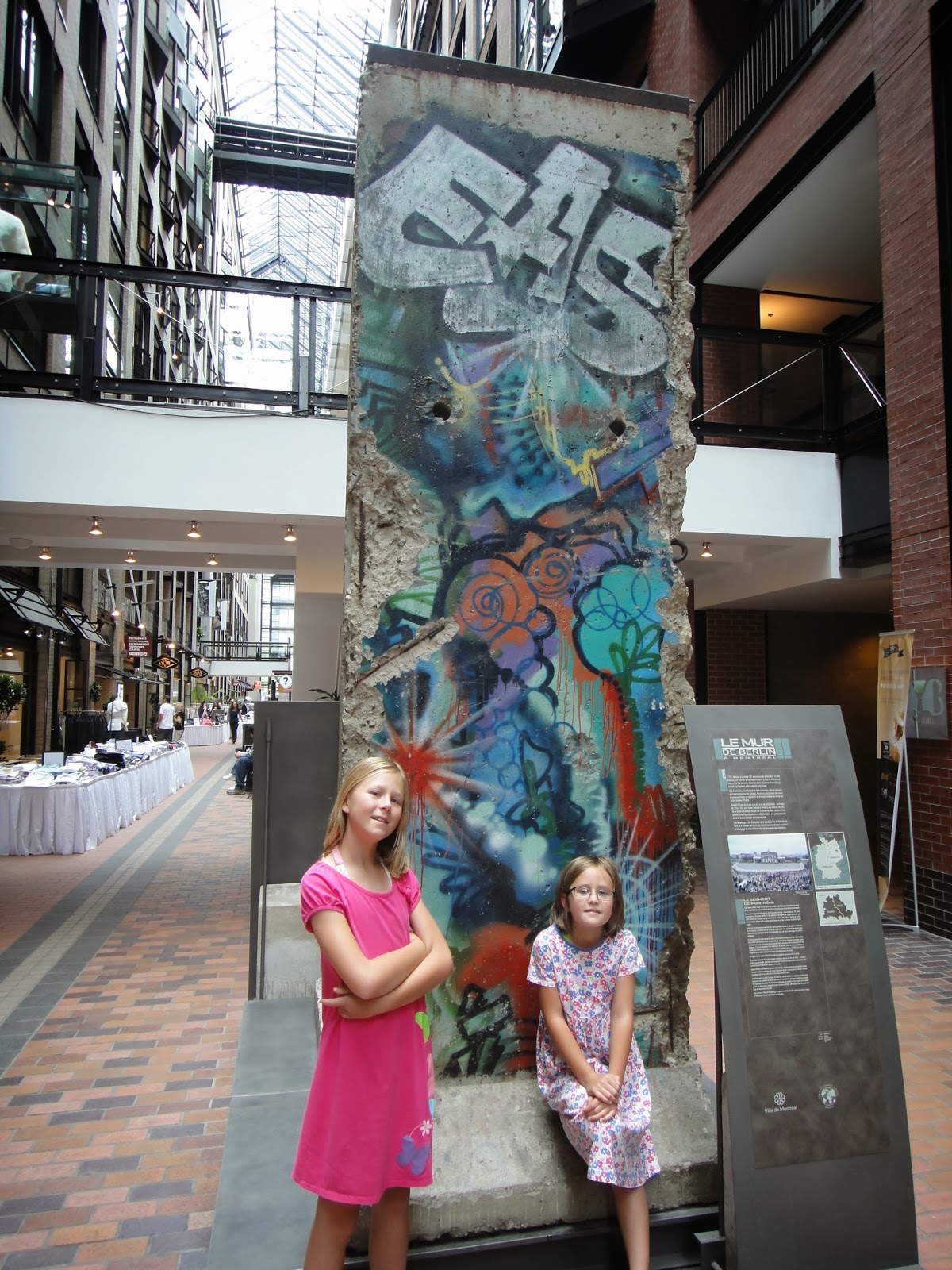
Today, this is a small regret of mine.  I could have gone to Berlin and seen the Wall – I would have arrived just months before the Wall came down and Germany was reunited, but of course I did not know that at the time.  The Wall is a relic which now exists only in small pieces, scattered across the globe.  I happened upon a slab from the Berlin Wall in the underground Montréal RÉSO in 2011, on display between a handbag shop and a café.  How ironic, I thought, that this barrier against capitalism was encased in museum glass in that most capitalist of places, a North American shopping mall.  Seeing an artifact of history on display is a far cry from experiencing what life was like for the everyday people who lived it, though. 


As I reflect upon the courage of those students in 1989 Beijing, there’s nothing funny or ironic.  Those protestors who survived would be my age or older today.  What repercussions did they and their families suffer?  This week I came across an essay by Da Chen, who grew up in China during the 1970s.  In his essay, about the book that changed his life, he described how no reading material was available in his village unless written by Mao Zedong himself.  He and his friends were so hungry for books that when a pay lending library opened up in the village, he and his friends stole recyclables – what we Americans consider garbage –  to resell in order to have money.  The library patrons would pay approximately one penny to sit in the library and read what they could.  The next day they’d have to pay again to continue to read.  The book he couldn’t get enough of was The Count of Monte Cristo, and in fact, he and his friends spent most of their time in the library secretly copying books by hand so they could share them with each other later.  After a brief existence, the library mysteriously went up in flames, its owner barricaded inside.  The owner managed to escape but was arrested for the crime of loaning books.  After reading this essay, I couldn’t look at my piles of books, so casually stacked, so easily discarded.  Da Chen’s story brought me back to Tiananmen and also to the contrast of my life, now and then, to the brave souls there. 

They were so like me in some ways, hungry for the same rights I figured I deserved:  to travel, to study, to read, to gather with like-minded people.  I took some of these for granted, and gave the others no second thought.  How many days out of the year do I still take them for granted?  When I look back with some degree of regret on the road not taken to Berlin – because I was scared – I wonder where their courage came from.  The courage to stand in front of a line of tanks and not waver.  The courage to carry the wounded in rickshaws to hospitals while under gunfire.  The courage to care more about something as intangible as liberty than their own personal safety.  I can only wonder how tightly woven are hunger and courage, how many light-years away they are from comfort and apathy, what happens when courage is extinguished as it was so forcefully in 1989, and what form it might take when it returns.


23 May 2014

The Spirit of West Fork

The West Fork of Oak Creek is burning, Dan tells me, though perhaps the fire jumped over the canyon and spared it.  But I picture charcoal on sandstone.  The maples, barely leafed out this spring, no longer permitting the sun to admire their green hands held parallel to this earth.  Those golden cliffs, smudged with smoke, blackened timber floating in the fouled water.  How many times have I chosen to spend my birthday weekend there, among the falling autumn leaves?  West Fork is one of the most lovely places in this state, holding its own even when compared to the Grand Canyon or the lush Sonoran desert. 

I can’t sleep, worrying how much of it has burned.  The trees will come back, I tell myself.  Having just hiked through the Granite Mountain Wilderness, which burned last summer, I’ve seen the evidence of nature’s regenerative strengths first hand.  The wildflowers carpeting the burned areas there were breathtaking.  It would take decades, though, for the West Fork to be restored, perhaps longer than my endless numbered days.

One summer about twenty years ago, I hiked the length of the West Fork with Dan and Mike.  Judy shuttled us into the wilderness high above the canyon, through a maze of forest service roads so tangled I fretted that she might not find her way out alone.  We’d see her again three days later, meeting up with her and Rachel and Steve, who would hike upstream toward us.  The canyon was our trail and we set off downstream, happy to be on our feet and done with the jostling four-wheel-drive ride.


We’d have to ford a couple of long, deep pools, Mike had cautioned.  When we came to the first, he sat cross-legged on the sandstone and unrolled an ancient pool raft.  Calmly and deliberately, he blew, coaxing the raft into shape.  When it was ready, he and Dan lowered it into the pool and placed one of our backpacks on it.  They hung on either side of the heavy load, like pallbearers, and floated it across the pool.  They paddled across like dogs, keeping their grip on the pack-raft and their eyes on the goal of dry gear, and then returned for the next one.  The dark pools were framed by steep canyon walls that blocked out the sun’s warming rays.     The water was so cold it was a struggle to breathe.  It felt as if the cold squeezed all the breath out of me.  Even though it was July, I shivered uncontrollably after I’d crossed, my teeth chattering loud enough to rouse the spirits from the walls.  There were three pools we had to traverse that first day in this manner.


After the last one, we were cold and soaked again, but our gear was still dry, thanks to Mike’s raft.  A flask of scotch was revealed, a nip to warm us.  I took a swig but still trembled, the only warmth travelling straight from my mouth to my belly.  I turned to hoist my pack, hoping that moving towards that night’s camp would warm me.  I took one step and found myself flung hard against the cold sandstone.  The scotch, the slippery algae, fatigue – any number of reasons might explain why I’d tripped.  I sported a few rock kisses, but was fine. 

We were alone there in that remote end of the canyon, as few people venture on the back roads, choosing instead to park at the trailhead just off the highway where the West Fork meets the main creek.  I don’t remember coming across anyone else that first day.  By the time we met back up with Judy and Rachel and Steve, though, we’d encountered throngs of visitors who congregated from the other end of the canyon into this exceptional place.  We spent one last night in the canyon, playing cribbage by lamp light and watching the mice scamper into our camp looking for crumbs.  The next morning, we’d head home.  By then it would be raining, and we’d be cold and wet again, and somewhat miserable to be heading back to our jobs and life in the city.  For now, though, we continued downstream, cold and wet, but in high spirits, our laughter echoing within those canyon walls. 


03 May 2014

The Queen of Tamales

My father drives up to Dick and Eva’s little house, nestled in the grassy oak-studded hills.  Here, already, my memory grows hazy, if it serves at all.  It’s just me and my parents in the truck.  This is perplexing, as I can’t recall why I would be in Sonoita with my parents but without my siblings.  I remember myself as college-aged.  The sequence of memory here is almost dream-like, and just as in a dream, I’ll follow the thread as far as it takes me. Other trucks are parked in the grass and an ugly ranch dog comes up to inspect and greet us as we disembark.

Dick and Eva used to live on the Crown C Ranch where he was the head ranch hand for decades.  Granny Jane was one of several dear friends of my long-deceased paternal grandparents and she owned the ranch in these borderlands.  We visited her often, as if she were our grandmother.  Our times there are among my favorite childhood memories: playing outdoors, riding horses, gathering acorns, and building a fort in the dry wash in front of the huge main house.  I remember Dick as quiet and warm, with crinkly eyes that sparkled from under his big cowboy hat, and huge strong hands, gained from a life of working outdoors.  He never spoke to me much, but was a legend to us kids, as he’d survived a lightning strike that killed his horse.  Eva was something else altogether, slim and sharp-tongued, and not afraid of calling us kids on our shit when we crossed the line.  Hers was tough love before that was a term people used.  As a child, I was terrified of her, even though I knew she meant well.

But I return to the dream-like memory, as an aproned woman opens the door to Eva’s tiny house and bids us to enter.  I don’t recognize her, but she knows us, including my name, and squeezes each of us as we enter the house, embracing us in quick warm hugs, her face flushed bright.  It dawns on me later that this is Mercy, short for Mercedes, Eva’s daughter.  There are several other women here in the kitchen-living room, and it’s noisy and too warm and smells delicious.  I spot Eva at the stove, stirring a huge pot and casting orders in her unique mix of Spanish and English.  She sees us and comes to say hello, spoon in hand.  She hugs my dad first, because he’s her favorite, of course, kissing him on the cheek and joking with him about something I can’t hear.  He’s known her for much of his life and looks like a boy in the beam of light that her face shines upon his.  She hugs my mom and then says to me, pointing the wooden spoon, “I hear you no doing good.  You need more study.” She always reserved her tenderness for my dad and her smiles and jokes for my brother Colin.  The rest of us, it felt, did not live up to the expectations of this ad hoc tia of ours, who loved our dad so.  But she takes my hand and pulls me to the stove. 

It’s a cast iron wood stove in my memory, the kind I imagine the pioneers might have used.  But it’s what Eva prefers, even here in her new modern house with a real shingle roof.  They moved here after Granny Jane died and the ranch was sold.  It’s a much nicer house than the tin-roofed house they lived in when I was a kid, but she didn’t want an electric or gas stove.  This is the kind of stove she knows.

But here, now, I am her focus:  the gringa girl.  No introductions are made because they all know me, or did when I was a little girl and came to the ranch for Easter and lazy summer visits.  I’m bewildered and it doesn’t occur to anyone that I don’t know the names of the other women.  But I am folded into the group and assigned a task that I’m not sure I can do since I don’t understand the mostly-Spanish language that’s floating around the room.  Everyone talks at once and although it appears that each of the women is giving orders, Eva is definitely in charge.  They are making tamales, more tamales than I can fathom.

Eva is mixing the masa in the largest pot I have ever seen.  It’s almost a caldron, really.  In another large pot, corn husks are bathing in steam until they’re pliable and soft.  I can’t even recall now if the tamales were green corn and green chile, or pork or beef with olives.  But I remember this.  I stand, sweating and watching the skilled hands of many women work quickly and gracefully.  Dozens of tamales are made in my presence, instructions relayed in a language I barely comprehend, but I watch and learn, slowly, folding and rolling the piping hot corn husks as my fingers are burn-numbed again and again.  It’s like watching Baryshnikov dance and then trying to imitate his elegance.  My tamales are lumpy and misshapen compared to the ordered rows the other women make.

We work and work, the women squawking and laughing, this small army creating more tamales than I’ve seen in my entire life.  They’ll share them with friends and family, eat them at Christmas and throughout the winter.  The tamales are everywhere, in the pans, bags, and boxes lining counters.  Again and again, the masa is spread on the husk, the topping daubed on.  One end of the husk is folded against the masa and then the entire creation is rolled and placed in the steamer.  Finally, even Eva herself is exhausted, although her eyes are still bright and she’s still barking orders.  She lowers herself in a creaky kitchen chair, holding the spoon like a scepter.  My mother sits beside her, a lady-in-waiting.

In the frenzy of the kitchen, I hadn’t noticed my father outside, leaning against the truck with Dick.  It is dusk now and the old ranch dog is watchful at their boots.  I am suddenly drained, the heat oppressive.  The women begin washing dishes, bagging the rest of the tamales, sweeping the floor.  I stand near an open window, the November air cold and welcome.  I wipe the pots with a soft cotton towel imprinted with the year of my birth.  I catch snippets of the conversations inside and out, but I am so tired and my hands are so scalded I have to concentrate on what I’m holding.

One by one the women leave as tasks are finished, each with grocery sacks filled with our collective labors.  Eva calls to them, “Hasta la bye-bye!” and they answer in kind.  Their trucks pull away, red taillights glowing like the cherries of cigarettes.  Eva folds me into a hug with a whisper, “You work hard.”  Is it a compliment or a command?  I let my heart decide.  She squeezes my cheek and the flint in her eyes softens. My mother and I are escorted into the darkness and we say our goodbyes.   My own bundle of tamales is warm against my belly as the truck jostles down the dirt road, the headlights illuminating grass the color of masa.