21 June 2019

Fulbright TGC Day 3: Lima

Lima is a huge city and today we began to appreciate the distance between various districts.  By appreciate, I do not mean "to cherish," but rather "to understand the full scale of" because there is little to cherish about the difficult situation of traffic in Lima.  Everyone drives a car, takes a bus, or a taxi, or a combi (kind of like a van/bus combo), or rides a motorcycle.  Streets are incredibly congested and the driving rules that I am used to do not apply.  The distance between vehicles is sometimes far too close for my comfort.  Luckily, I am not in the driver's seat.  

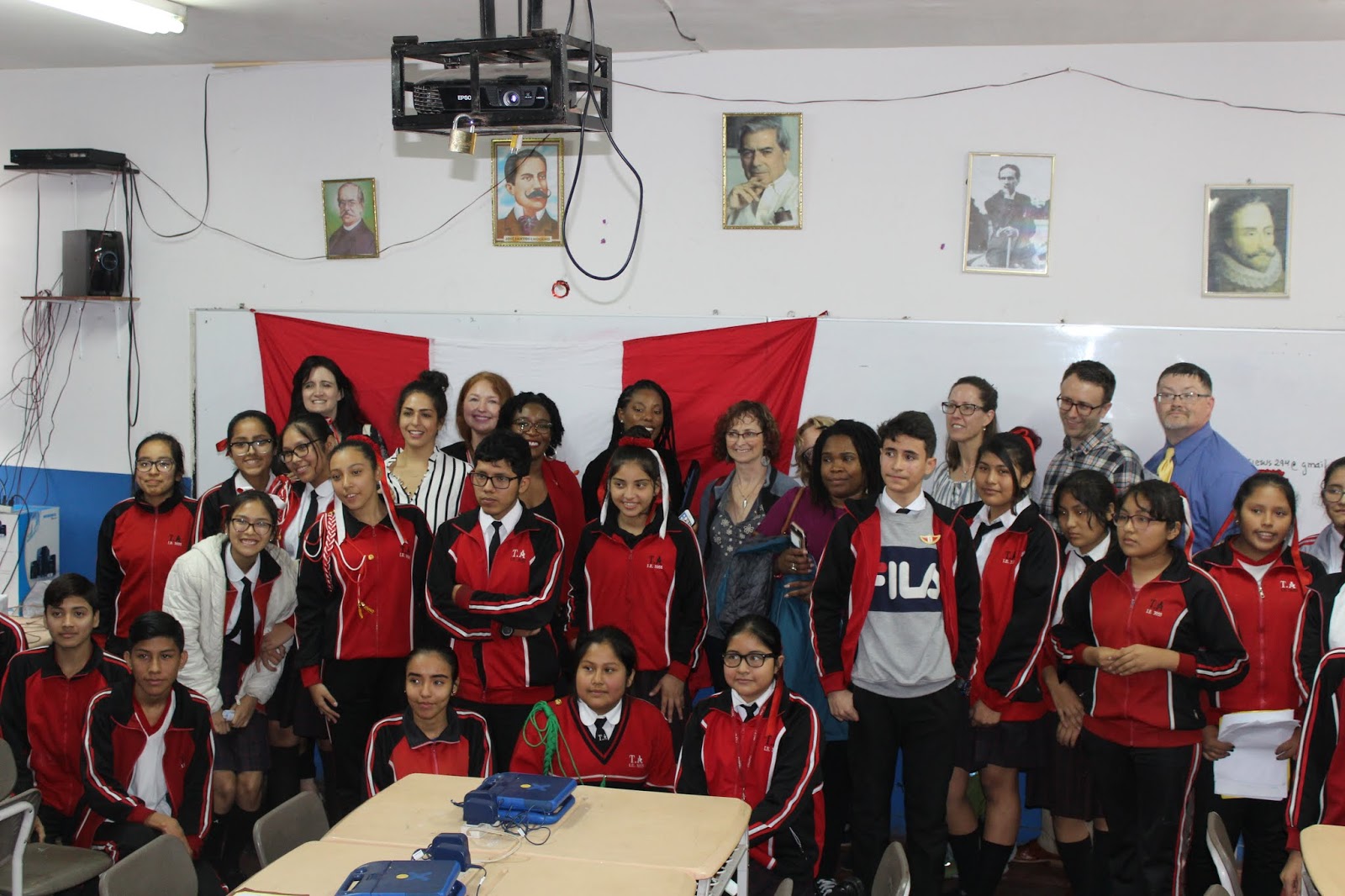
We traveled to two schools in the Comas District which is far to the north, about fifteen miles from our hotel in Miraflores.  The first school is named for Túpac Amaru, the last Sapa Inca who resisted the Spanish Conquistadores but was ultimately executed by them in 1572 in Cuzco.  His is a rather dramatic story, especially of his capture and public execution, which was witnessed by crowds estimated at 10-15,000 people.  "A multitude of Indians, who completely filled the square, saw that lamentable spectacle [and knew] that their lord and Inca was to die, they deafened the skies, making them reverberate with their cries and wailing,"according to Murúa, and the legality of the Spanish executing someone that they had previously recognized as a sovereign king set off a debate which eventually became the foundations of international law.  John Heming's The Conquest of the Inca tells the history of this event and those leading up to it in great detail.


At Túpac Amaru we were greeted first by teachers and administrators with warm hugs and cheek kisses.  Two former students lead us on tours of the campus, speaking fluent English and answering our questions.  Students in classrooms were practically falling over themselves trying to say hello to us - when we approached a classroom we could hear their excitement rising.  They were eager to practice their English and for many of them, we were the first Americans they'd met.  After the quick tour, we had a round table activity where we sat with small groups of students and talked.  These same activities were repeated at the next school.


Some observations on the schools:


  • Although these schools were in a relatively poor area, many of the students had cellphones.  I did not expect this.  They were using Google Translate to look up things they did not know how to say in English.  
  • I got to speak a lot of Spanish with them which was super fun.  
  • These students were so proud of their school.  They wear uniforms, which for most were cool track suits.  I was coveting their jackets.
  • Kids never once complained about their school or their teachers or the (lack of) resources.  I would have liked to talk with the teachers more to understand their perspective.
  • Kids are kids are kids.  The things the kids wanted to talk about, the things that made them laugh, the issues they see in the world are the same as my students.  Again, I am reminded that we are more similar than different, in spite of what the news media would have you believe.  
  • When asked what Peruvian foods we had tried and liked, they were so proud of their cuisine, especially ceviche and were so excited that we enjoyed it.
  • Working in a school district that is underfunded by American standards, it was very interesting to visit a school that obviously receives less funding.  Regardless, the students were proud and loved their school and loved learning.  They definitely value education.
Some things that would be cool to implement at my school:
  • Student leaders wore braided cords which designated them as holding various positions.  One that I found most interesting was a designation for students who were to assist in an emergency, such as an earthquake.  In the US, we have many drills to practice for a fire, a shooting, etc., but the responsibility is all on the teachers to ensure the safety of the students.  What if there were students who shared that responsibility?
  • There was a 15 minute recess period when all students were outside together.  These students were playing soccer and being active, talking with friends and walking.  Because the students stay in the classroom and the teacher moves from room to room here, this break was necessary. But what a great idea for the students to get some fresh air and have time to talk with one another.  At my school students rush during their 6 minute passing period and some do not even have time to use a restroom because our campus is so spread out.




19 June 2019

Fulbright TGC Day 2: Lima

It is amazing what a difference consecutive hours of sleep can do.  After a big breakfast, Violeta presented information to us regarding the Peruvian school system, which is a centralized system with a national curriculum taught in nearly every public school.  In Washington DC this winter, we learned some of the basic information about education in Peru and we were asked to develop guiding questions that are tailored to our individual interests and assignments here in Peru.  Mine are all related to language learning:

  • What opportunities exist for bilingual education?
  • What languages are taught?
  • Are indigenous languages taught elsewhere in Peru?
It was interesting for me to learn some partial answers to these questions today.  For the most part, English is a required subject, but it is not always taught by qualified teachers.  Not every English teacher actually speaks English, unfortunately.  There is a small movement to teach indigenous languages like Quechua (the language of the Incas) in those communities, but resources are scarce and qualified teachers are even more scarce.  

Language barriers remain a huge issue of equal access to education throughout the country, and just as in many places in the world, Arizona included, rural communities lack resources, expertise, and access that some schools in more urban areas have.  There are striking similarities between indigenous communities in Peru as well as places like the Navajo Nation.  There are few books published in Quechua or, say, Navajo, few libraries outside of a school in these communities, and few teachers who are fully trained and also have the culturally relevant backgrounds and understandings to help students in these communities reach their potential.  How do you recruit Native students to become educated and trained to return to these communities as teachers with the resources to meet the needs of these students?

***

We took a short walk to the Parque del Amor on the cliff overlooking the coast.  Surfers were braving the cold water on this foggy day.  The park is decorated with lovely mosaics depicting lines of poetry from Latin American poets and the names of famous couples like Florentino y Fermina from Gabriel Garcia Marquez's Love in the Time of Cholera.  My favorite appealed to the Scorpio in me:


This will be my revenge - that one day a book will arrive in your hands from a famous poet and you will read these lines that the author wrote for you and you will not know it.  -Ernesto Cardenal


Another section of the mosaics with the Pacific Ocean in the background.

After lunch we were taken to the Fulbright Foundation where we had some photo opportunities.


Our full group with Violeta.

Our next presentation was a detailed history of the Sendero Luminoso (Shining Path) Movement, which was a Marxist terrorist cult who committed extremely savage attacks in their attempt to lead a revolution in Peru.  This began in 1980 throughout 1992 when its leader, Abimael Guzman was captured, and until 1996 when it was finally defeated.  The people most affected by this group were Quechua-speaking young people living in the poorest regions; because of the remoteness and distance from Lima, the centralized government failed to intervene, and then later did so with equally violent effect.  The ramifications are still being felt today.  I think this tragic history is something that few Americans are even aware of in spite of the fact that it was not in the distant past.  Learning about this has made me realize how insulated and insular our sense of the world often is in the US.

We had a lovely dinner on our own this evening and I enjoyed a lovely Sopa de Criolla (rich broth with noodles, beef, and a poached egg).  


18 June 2019

Fulbright TGC Day 1: Lima

This evening as I sit to write this post I am amazed that I have been in Lima for just over twelve hours.  Most of my group arrived via Miami this morning after an overnight flight.  It's been an exhausting day but also so wonderful to see our fantastic Peru Crew once again after meeting in Washington DC this winter.  Our hotel is in Miraflores which is an upscale neighborhood right on the coast.  From my room I have a great view to the west of the ocean, however, due to the hazy, foggy quality of the air, it's not easy to determine where the sky ends and the ocean begins.


And that's definitely not a complaint, just an observation I have coming from a dry climate where we enjoy blue skies most days of the year.  I spent the morning relaxing and organizing and getting my bearings as I know that the next several weeks will be at a very intense pace.

Our first event today was a delicious lunch at our hotel followed by an interesting presentation and Q&A with Violetta, a Peruvian Fulbright based in Lima.  She gave us a brief overview of history and culture of Peru and was very willing to answer our questions and discuss similarities and differences between US and Peruvian customs, social issues, and education.

The afternoon and evening was spent driving through various neighborhoods in Lima and a walking tour of the historic district.  


One of my favorite signs in the neighborhood.  Lots of honking of car horns in Lima.


There is a wide variety of architectural styles in Lima, including this art deco residence.


Crossing an overpass.  This expressway is surprisingly empty of cars compared to other streets we drove on today.


Another example of architectural style from closer to the historic district.  The blue structure with white lettering is a phone booth!  I will try to get a photo of one tomorrow as I know of some younguns who have never seen one.


Peru played Bolivia today in soccer and at many venues there were crowds of people watching the game.  We were in the Plaza de Armas when Peru scored a goal and on all sides of the plaza cheers erupted.  Peru won 3-1.


The cathedral of Lima.  Note the different architectural styles due to rebuilding after major earthquake damage.  This church faces one side of the square, the presidential palace another, and the city hall a third.  The fourth side is lined with commercial businesses in a colonial building.  There was a heavy police presence here with riot shields and helmets, which our guide says is typical.  There are no demonstrations permitted within the square.


Details from the church of San Francisco.  Can you spy the adventurous gato?


Here is the gato, strolling along the cornice waaaaay up high, on the church of San Francisco.  Inside the grounds of this church are a working monastery with a beautiful and peaceful cloister, artwork from as early as the 1700s, and the catacombs of Lima, where thousands of (rich and connected) people were buried over the past few centuries.  Unfortunately no photos were permitted inside, but here is a peek.


The incredible Peru Crew in the square of San Francisco, hailing from Pennsylvania, Ohio, Louisiana, Maryland, New Jersey, Texas, and Arizona!


We ended our evening with an amazing meal on the grounds of Huaca Pucllana, the site of a pre-Incan archaeological importance in the middle of the Miraflores district.  This site was built between 200 and 700 CE of adobe brick.  The brick is so well-preserved because it rarely rains hard in Lima and so erosion has not damaged it as much as might be an issue elsewhere.

First impressions of Lima:

  • It is a huge and sometimes chaotic city with a diverse style that I imagine reflects the diversity of the people.
  • The impact of the Spanish colonization is everywhere.  This city was the Spaniards' city in Peru  and remains the seat of power today.
  • There is amazing public art and graffiti everywhere.
  • Peruvian people are very welcoming, engaging, and friendly.  We have been welcomed with an abundance of generosity.
  • The food is probably the best kept secret on the planet.  If what we ate today is any indication, we will all gain weight on this adventure - lomo saltado, causa, and ceviche were all excellent.
  • Did I mention the amazing coffee?  And pisco sour (similar to a margarita but sweeter)?


15 April 2019

Notre Dame is Burning

Notre Dame is burning. The full extent of the damage is yet to be known, but my gut tells me it is devastated to such a degree that it will not be fully restored during my lifetime.  Like many, I hold Notre Dame in a very special place in my heart.  One memory in particular kept floating to the surface today as I learned the news, first from a friend’s text.  My phone proceeded to blow up with texts from others, and many people came by my classroom today to share the developments and their grief.  

When I was twenty, I lived in Paris for a summer with an American roommate, Sandi, and a kind and welcoming French family.  What Hemingway said is true – that if you live in Paris when you were young, it will stay with you, for Paris is a “moveable feast.”  I’m not sure that this is unique to Paris, or if we are able to romanticize any beautiful place we’ve lived in that was integral to our coming of age. Regardless, Paris is a magical and beautiful city – redesigned in the early 1800s by Haussmann at Napoleon’s request, it is a city intent upon making an impression.  After a while though, it also reveals its warts, which are mostly the same as any large city:  too many people in too small a space, pollution, trash, and the filthy sidewalks due to the Parisiens’ apathy about cleaning up after their dogs.  

Ask any city dweller where to go for respite, though, and they might reveal their secret.  New Yorkers might have a special location within Central Park; or the Bay Area residents’ affinity for their trails along the coast.  And while Paris boasts a surprising number of lovely parks, Notre Dame was my refuge:

It is Sunday afternoon in June 1989, and my roommate Sandi and I take the Métro north to Saint-Michel and walk across the bridge toward Notre Dame for the free weekly organ concert. We’ve been to the cathedral before, our course instructor gave us his personalized tour a week or two before. It’s a hot and humid day, the kind that makes our host, Béatrice, stand by the open window, fanning herself and saying, “Quelle chaleur!”  (What a heatwave!)  The sun is bright and the smog and noise of the traffic add to a growing oppressiveness.

As we enter the cathedral, our senses are overwhelmed.  First: the darkness of this vast cathedral, whose stained glass windows are high above and don’t permit much sunlight. The coolness of the walls holding in the chill of eight hundred winters envelopes us and we soon are on the verge of shivering.  Next, the smoky scent of incense, lingering from the recent Mass, permeates our nostrils. And finally, the hush of the audience as everyone takes a seat.  Already, I feel somewhat overcome by a sense of peace and calm.  The quick tempo of our language and history courses every morning, followed by afternoon excursions at the fast pace of our instructor, on top of the struggle of immersing ourselves in another language, culture, and family – all of it is too much.  In later years, I will come to realize that this experience has imbued me with a deep sense of empathy for immigrants and refugees and all displaced persons.  But for now, it seems like this is the first time I have just sat quietly since I dragged my jet-lagged self off the plane. I’m not trying to figure how to say what’s on my mind, I’m not being rushed to the next sight, I’m just sitting quietly.

And then, the organist begins to play.  The massive pipes of this organ seem to snake up the entire wall at the back of the nave. The music, filling the air, vibrates throughout the huge enclosed space.  It’s loud, very loud, and on top of the sensory overload I’m already experiencing, my face is wet.  Tears stream from my eyes and at some point I realize that audible sobs are emanating from me.  The music swells and builds, each beat filled with the infinite trills and ornamentation that define  French Baroque organ music.

By the end of the concert, I pull myself together, but I am utterly spent.  I remember Sandi leading me from the darkness of the cathedral into the afternoon sun.  My journal tells me that we ate at an Italian place around the corner, but I don’t recall the rest of the day.

And now Notre Dame lies in shambles – the only solace is that it appears that no one has been killed in the fire.  The efforts of the brave firefighters surely have saved the cathedral from utter ruin – and hopefully the injured first responder will recover completely.  Notre Dame will be rebuilt – Macron has already pledged an international fundraising effort to fund it.  It is truly the heart of Paris, indeed of France, with Kilomètre Zéro in its square.  To me, it will remain a place where I, a young and weary traveler, far from home, found an overwhelming sense of peace on a Sunday afternoon.  

02 April 2019

A New Focus

This blog has been radio silent for several months now.  I am revising and rechanneling this website and repurposing it so that it can serve as a Global Education Guide for my Fulbright Teachers for Global Classrooms Fellowship, in addition to continuing as a mode of self-expression.  I learned in August that I was awarded this prestigious fellowship.  Throughout the fall I was committed to an intense and rigorous course to learan all things related to Global Education and this revised website will serve as my capstone project.  This June I will travel with a small cohort of teachers to Peru to explore and learn about the school system there.

Ultimately this website will serve as a resource to anyone who is interested in learning about Global Education and implementing it into their lives, classrooms, schools, communities, etc.  Wanting to share the world with others was and remains a huge reason for my becoming a teacher.  Being part of this program has opened my eyes to the huge potential of what that can truly look like.

I spent three whirlwind days in Washington DC in February, completely missing the Blizzard of '19, which envelopped my community.  I met my amazing Peru Crew cohort -  a total of ten fantastic teachers with whom I will travel and work with this summer.  We experienced several incredible workshops to prepare us for our international field experience and to help us implement global education into our classrooms, schools, and communities.

While I still intend to write regularly and share those pieces here, much of my energy and focus will be on creating a platform to share the resources and experiences regarding my global education journey and to invite you along with me.